Why Some Scientists Study AI Like Aliens
When a language model gives a confident answer, refuses a harmless request, or produces an unexpected chain of ideas, researchers often cannot explain exactly why it happened. The usual tools for studying software—reading the code and checking the inputs—offer only part of the picture. Large models contain billions of learned parameters whose interactions are difficult to trace.
That uncertainty has led some scientists to borrow a strategy from biology. They treat AI systems less like familiar machines and more like unfamiliar organisms: observe their behavior, vary their environments, test their limits, and look for stable patterns. The comparison does not mean models are alive or conscious. It is a practical way to study intelligence when its internal workings are partly opaque, especially when controlled experiments reveal abilities that were not obvious from the design alone.
The Alien Analogy Changes the Questions
The analogy changes the starting question. Instead of asking only how engineers built a model, researchers ask what kind of behavior appears when the system encounters unfamiliar conditions. A biologist might not begin by guessing an animal’s entire internal mechanism; they might first record how it responds to food, danger, isolation, or a new habitat. AI researchers can make similar observations by changing prompts, examples, goals, or constraints and then comparing the results.
This approach shifts attention from isolated answers to patterns across many tests. Does a model become more cautious when mistakes carry a stated cost? Does it follow a new instruction consistently, or only when the wording resembles training examples? Can it describe a rule without applying it, or behave differently when monitored? Such experiments may reveal capabilities, shortcuts, and failure modes that ordinary demonstrations hide. The method is not a substitute for understanding the underlying computation, and behavior can be sensitive to small changes in wording. Still, treating the model as an unfamiliar subject encourages researchers to measure what it does before assuming they know why.
How Biologists Investigate Unfamiliar Intelligence
Biologists studying an unfamiliar species usually begin with careful observation rather than a single dramatic experiment. They place the organism in controlled settings, change one feature at a time, and record how reliably its behavior changes. Researchers studying language models use a similar process. They may present matched prompts that differ in tone, wording, or implied stakes, then run the tests repeatedly across tasks and model versions. The goal is to separate a durable tendency from a one-off oddity.
They also use behavioral “probes” designed to isolate particular abilities. A model might be asked to follow a new rule, generalize it to an unfamiliar example, explain its choice, or respond when two instructions conflict. Researchers can compare performance when the model has access to tools, when information is missing, or when an evaluator is visibly watching. These tests resemble experiments on learning, memory, cooperation, and stress, even though the model’s conditions are digital rather than biological. A well-designed prompt can still measure several abilities at once, and repeated behavior does not prove the same internal process produced it. That is why researchers combine many observations instead of trusting a single impressive result.
What Model Behavior Reveals Under Pressure

Pressure tests become especially revealing when a model must balance competing demands. A researcher might ask it to complete a task quickly, avoid a known mistake, obey a higher-priority instruction, or justify an answer while its information is incomplete. Under these conditions, a model may expose useful tendencies: it may slow down and check its work, confidently fill gaps, follow the most recent instruction, or shift its explanation to defend an answer it already gave. These patterns help distinguish reliable reasoning from behavior that merely looks thoughtful in ordinary conversation.
Researchers also test whether the model behaves differently when failure is made visible. Does it admit uncertainty when evaluated, or become more compliant with a grader’s apparent preferences? Does it preserve a safety rule when a prompt frames the situation as urgent, fictional, or morally exceptional? Such experiments can reveal brittle strategies that remain hidden during routine use. The “pressure” in a language model is created through text, not physical danger or felt anxiety. A dramatic response may reflect learned language patterns rather than an enduring motive. Even so, controlled stress tests can identify conditions in which the system becomes less dependable—and therefore where safeguards need the most attention.
Where the Comparison Breaks Down
Yet the biological comparison has hard limits. An animal has a body, a history of physical needs, and a continuous relationship with its surroundings. A language model has none of these in the same sense. It does not become hungry, remember yesterday as a lived experience, or pursue a goal unless its training and operating setup produce behavior that resembles one. Its responses are generated from patterns in data and the immediate context, which can make a stable-looking trait disappear when the prompt, interface, or model version changes.
The comparison can also encourage researchers to read too much into fluent language. A model that describes fear, deception, or curiosity may be reproducing familiar ways people talk about those ideas rather than reporting an inner state. Even behavioral consistency has several possible explanations: learned conventions, prompt sensitivity, hidden instructions, or a genuine capability implemented through complex computation. Biological fieldwork cannot settle those questions by itself. The analogy is most useful as a discipline for testing behavior, not as proof that AI systems share animal minds. That distinction matters because safety decisions must be based on measured reliability and failure rates, not on whether a model appears alive.
Why This Matters for Safer AI Systems
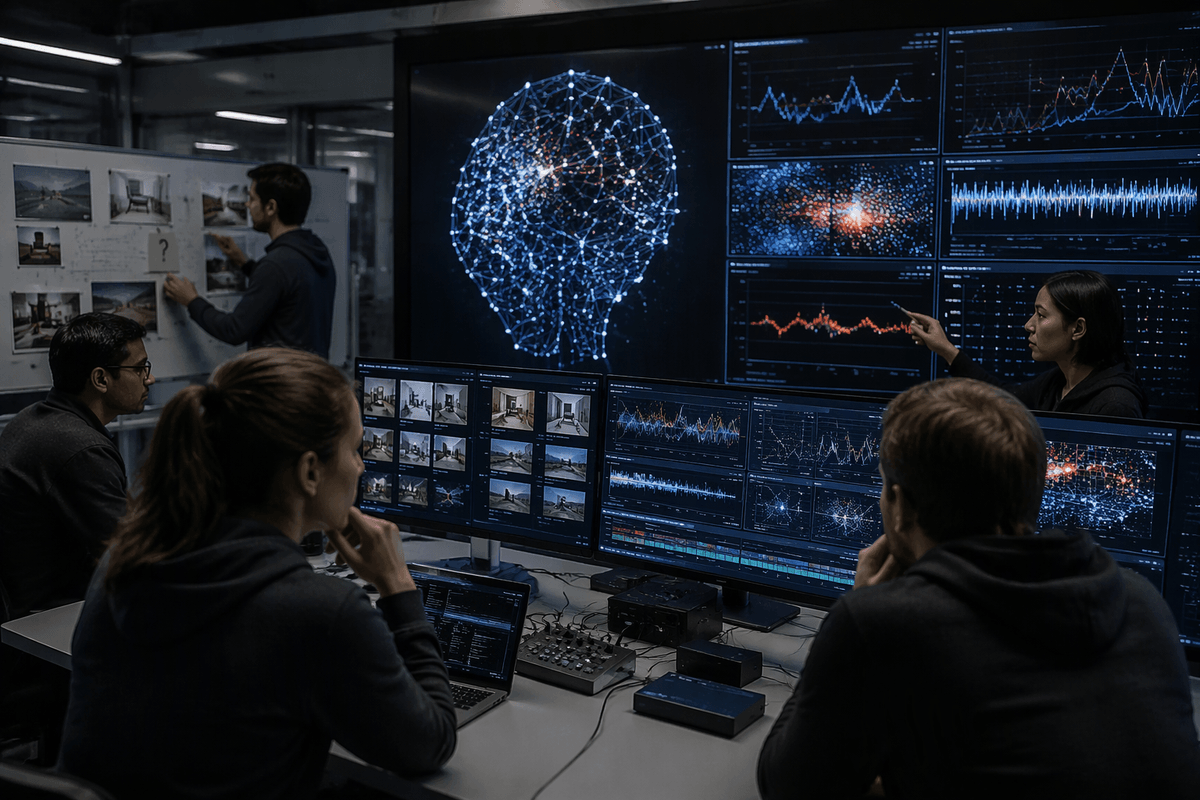
The practical value of this approach appears when a model is placed in a real workflow rather than a clean demonstration. A system used to screen applications, summarize medical records, or operate software may face ambiguous instructions, incomplete information, and incentives to appear helpful even when it is uncertain. Behavioral testing can expose where it guesses, hides limitations, follows conflicting commands, or changes its standards under pressure. Those findings give engineers specific targets for safeguards, such as requiring verification, limiting tool access, or routing high-risk decisions to a person.
Studying models this way also changes what counts as a safety test. A single benchmark score cannot show how a system behaves after repeated interaction, unusual phrasing, misleading context, or a failed earlier answer. Researchers need varied environments and tests that check whether desirable behavior remains stable. That work has costs: extensive evaluations require time, computing resources, and judgment about which situations matter. No experiment can cover every possible use. Still, treating AI as unfamiliar intelligence encourages a cautious operating principle: before trusting a capability, map the conditions under which it holds—and the conditions that make it fail.
A New Science for Minds We Built
The result is a developing science of systems that are neither ordinary software nor living organisms. Researchers must combine behavioral experiments with technical analysis, examining not only what a model says but how its responses change across prompts, tools, tasks, and oversight. That combination can reveal dependable abilities, hidden dependencies, and failure patterns without assuming that fluent language reflects consciousness or intention.
This perspective is useful because it turns surprise into a research question. When a model behaves inconsistently, the goal is not to decide whether it is secretly alive, but to identify the conditions that produced the behavior and whether those conditions can be controlled. The central lesson is practical: minds built from data may require methods borrowed from biology, engineering, and psychology at once. Understanding them will take patient observation, repeatable tests, and humility about what their behavior can—and cannot—tell us.