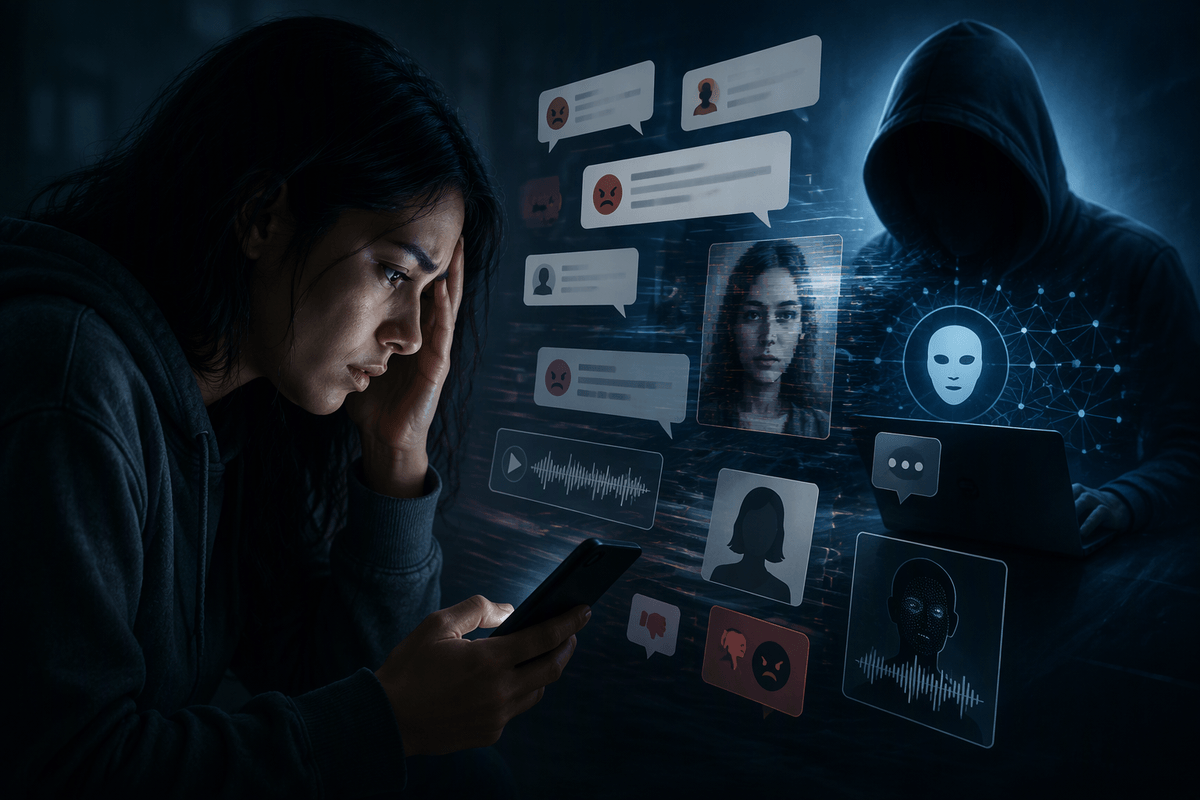
Harassment Is Scaling Beyond Human Limits
A cruel message once took time to write, send, and repeat. Now a person can use AI to produce dozens of hostile posts, realistic impersonations, altered images, or scam messages in minutes. That changes the scale of abuse even when the underlying behavior is familiar: humiliation, intimidation, stalking, and exclusion.
Every online conflict will involve sophisticated deepfakes. It is that cheap, widely available tools let one determined abuser create more material, target more people, and make false claims look more convincing. A student, employee, teacher, or local organizer may suddenly face a volume of abuse that is difficult to document, report, or answer alone.
What AI Makes Easier for Abusers

Consider how little evidence people often need before they share a rumor: a familiar name, a believable screenshot, a voice clip, or an image that appears to come from a real account. AI lowers the effort required to manufacture each of those signals. An abuser can imitate someone’s writing style, generate fake messages, alter ordinary photos into sexualized images, or clone a voice for a threatening call or a false request for money.
It also makes harassment easier to personalize. Public posts, school pages, workplace bios, and social profiles can supply details that make a fake message feel credible to a classmate, parent, colleague, or customer. Automated tools can then vary the wording and send it repeatedly, making abuse look like it comes from many people rather than one source. The tools do not remove the abuser’s intent, but they reduce the time, skill, and cost needed to cause confusion, reputational damage, and fear.
The Harm Is More Than Fake Content
For the person targeted, the most immediate harm is often the uncertainty. A fabricated image or message can force them to prove that something did not happen while friends, classmates, coworkers, or family members decide what to believe. Even when a fake is eventually removed, screenshots and reposts may remain, and the person may change routines, leave online spaces, or avoid school and work out of embarrassment or concern for their safety.
AI-enabled abuse can also damage relationships that depend on trust. A parent may receive a cloned-voice call that sounds like a child in trouble. A manager may see a convincing fake exchange that appears to show misconduct. A local volunteer may be impersonated to solicit money from neighbors. The technical question of whether content is authentic matters, but the social damage can begin before anyone checks.
That is why treating these incidents as mere misinformation misses the point. They can become tools for coercion, isolation, financial loss, and sustained intimidation.
Who Faces the Greatest Exposure First
The first targets are often people whose identities are easy to copy and whose social position makes a rumor costly: teenagers, women and girls, public-facing workers, teachers, community leaders, and people already facing racism, misogyny, homophobia, or other forms of bias. A few public photos, a short video, or a sample of someone’s writing may be enough to create material that appears personal and believable.
Exposure also rises when a person depends on a close network that can react quickly. A student may worry about classmates sharing an altered image before school starts. An employee may fear a fake message reaching a supervisor or client. A small-business owner or local official may be targeted because customers and neighbors recognize their name. People with limited privacy, limited institutional support, or little experience reporting digital abuse can face the hardest choices: ignore it, respond publicly, or spend time and money trying to contain it.
Platforms Still Struggle to Keep Up

When a fake image or impersonation begins circulating, the obvious step is to report it. Yet reporting systems were largely built for individual posts, clear policy violations, and slower-moving disputes. A target may need to file separate reports for copied accounts, reposts, direct messages, altered images, and threats, while explaining the same situation repeatedly. By the time a platform reviews the evidence, the material may have reached a school, workplace, family group, or local community page.
Automated filters can miss a convincing fake that contains no obvious slur or banned phrase, while aggressive filtering can wrongly remove legitimate satire, documentation, or discussion. Human review adds context but takes time and costs money. Clearer reporting paths, faster preservation of evidence, limits on repeat impersonation, and responsive escalation for sexualized or threatening fakes would not stop every incident. They would, however, reduce the burden placed on the person being targeted to act as investigator, advocate, and crisis manager at once.
What to Do When Synthetic Abuse Appears
The first hours after a fake appears can feel urgent, especially when it is spreading among people the target knows. Start by preserving evidence before accounts disappear or posts change: save screenshots, links, usernames, dates, messages, and any details showing where the material was shared. Avoid reposting the content widely while documenting it, since that can extend its reach. Report the account and the specific content through the platform’s impersonation, harassment, nonconsensual-image, or threat channels, and keep a record of report numbers and responses.
The person targeted should not have to manage the situation alone. A parent, school administrator, manager, union representative, or trusted friend can help sort evidence, contact relevant platforms, and warn affected people without repeating the false claim. If the abuse includes sexualized images, credible threats, stalking, extortion, or financial fraud, it may require prompt contact with law enforcement, a victim-support service, a bank, or an attorney. The practical goal is containment: preserve proof, reduce further sharing, secure accounts, and bring in support early.
Treating AI Harassment as a Safety Issue
A school, workplace, or community group should approach a convincing fake much as it would approach any other credible threat to a person’s safety and ability to participate. That means having a clear contact point, protecting the target from retaliation, preserving evidence, and deciding quickly whether others need a careful warning. The response should not depend on whether staff can immediately prove how the content was made.
Is someone being intimidated, isolated, sexually exploited, defrauded, or placed at risk offline? AI may change the method, but it does not make the harm less real. Institutions that plan for these incidents before they occur can respond with less confusion and leave fewer people to face a fast-moving crisis alone.