Why AI’s Answers Still Feel Unexplained
When an AI system recommends a loan, flags a medical image, or produces a confident answer, the result can look more certain than the process behind it. The model may identify useful patterns, but it usually cannot point to a short, reliable chain of reasons that a person can inspect. Its internal calculations are spread across millions or billions of numerical settings, making the path from input to output difficult to trace.
That does not mean researchers know nothing about what happens inside. They can study activations, test specific inputs, and find recurring features or behaviors. The harder question is whether those observations capture the model’s actual reasoning or only a convenient approximation. An explanation may sound plausible while leaving important causes hidden, especially when small changes in the input produce unexpected results.
Meet the Scientist Looking Beneath the Surface
That uncertainty is the problem faced by scientists such as Anthropic researcher Chris Olah, one of the most visible figures in modern AI interpretability. His work begins with a practical question: if a model contains useful internal concepts, can researchers find where those concepts appear and observe how they influence an answer? Rather than treating the model as a single mysterious object, interpretability researchers examine its smaller parts—patterns of activation, connections between them, and the changes that follow when an input is altered.
This approach resembles studying a complex machine by tracing signals through its components, but the comparison has a serious limitation. A neural network does not store every idea in one neatly labeled location. Many features overlap, and the same internal pattern may contribute to different tasks depending on context. Researchers can sometimes identify evidence for concepts such as text formatting, objects, or factual associations, yet finding a feature does not automatically prove that it caused a particular response. The scientist’s task is therefore less like reading a transcript and more like building, testing, and revising a map of hidden activity.
What Researchers Actually See Inside Models

What researchers see is not a hidden sentence or a miniature decision tree. They see numerical activity changing across layers as the model processes an input. Some groups analyze which units become more active when the system encounters a particular word, image feature, or grammatical structure. Others compare the model’s behavior after carefully changing one input, suppressing an internal signal, or introducing a new connection. These experiments can reveal relationships between internal activity and visible outputs.
Researchers may also identify small groups of components that work together on a task, sometimes called circuits. A circuit might help track a name through a paragraph, recognize a visual pattern, or copy information from one part of a prompt to another. But these findings remain partial. The same output can depend on several overlapping pathways, and a component that appears important in one test may matter less in another. Tools that make patterns easier to isolate can also simplify or distort them. Interpretability therefore produces testable clues about a model’s operation, not a complete translation of everything it “knows.”
The Difference Between Patterns and Reasoning
A model can recognize a pattern without reasoning about it in the human sense. For example, it may connect certain words with a likely answer because those combinations appeared often in training, or detect that a question resembles examples associated with a particular conclusion. The result can be useful and even surprisingly accurate, but the model may not possess a stable explanation that it could apply consistently in a new situation. What looks like a reason may instead be a collection of learned associations distributed across many internal pathways.
That distinction matters when researchers test an explanation. If activating a suspected feature makes the model more likely to produce a certain answer, the feature may be involved without being the model’s sole cause or conscious justification. A system can also produce the same answer through different routes, depending on the wording, surrounding context, or competing signals. Interpretability experiments can separate correlation from stronger evidence by intervening on those signals and checking whether the behavior changes. Even then, success on a carefully designed test does not guarantee reliable reasoning in unfamiliar conditions. The practical challenge is to determine whether an identified pattern generalizes—or merely matches the experiment.
Where Interpretability Runs Into Hard Limits
A model can become difficult to inspect simply because its useful information is distributed. One concept may be represented across many components, while each component participates in several unrelated tasks. This creates a problem known as feature overlap: isolating one signal may reveal only part of the process, and removing it may cause the model to compensate through another pathway. Larger systems also add practical costs. Mapping their internal activity requires substantial computing power, carefully designed experiments, and judgments about which patterns matter.
An explanation can describe how a model produced an answer without showing that the answer was reliable. Researchers may trace a pathway for a familiar example, yet the same pathway can behave differently under new wording, unusual data, or conflicting instructions. Tests can also miss interactions that appear only when many signals combine. For that reason, interpretability is not a single inspection that certifies a model as safe. It is an ongoing process of forming hypotheses, testing interventions, and checking whether findings hold across situations. A convincing explanation must survive changes in context, not merely fit one successful demonstration.
What These Discoveries Could Change
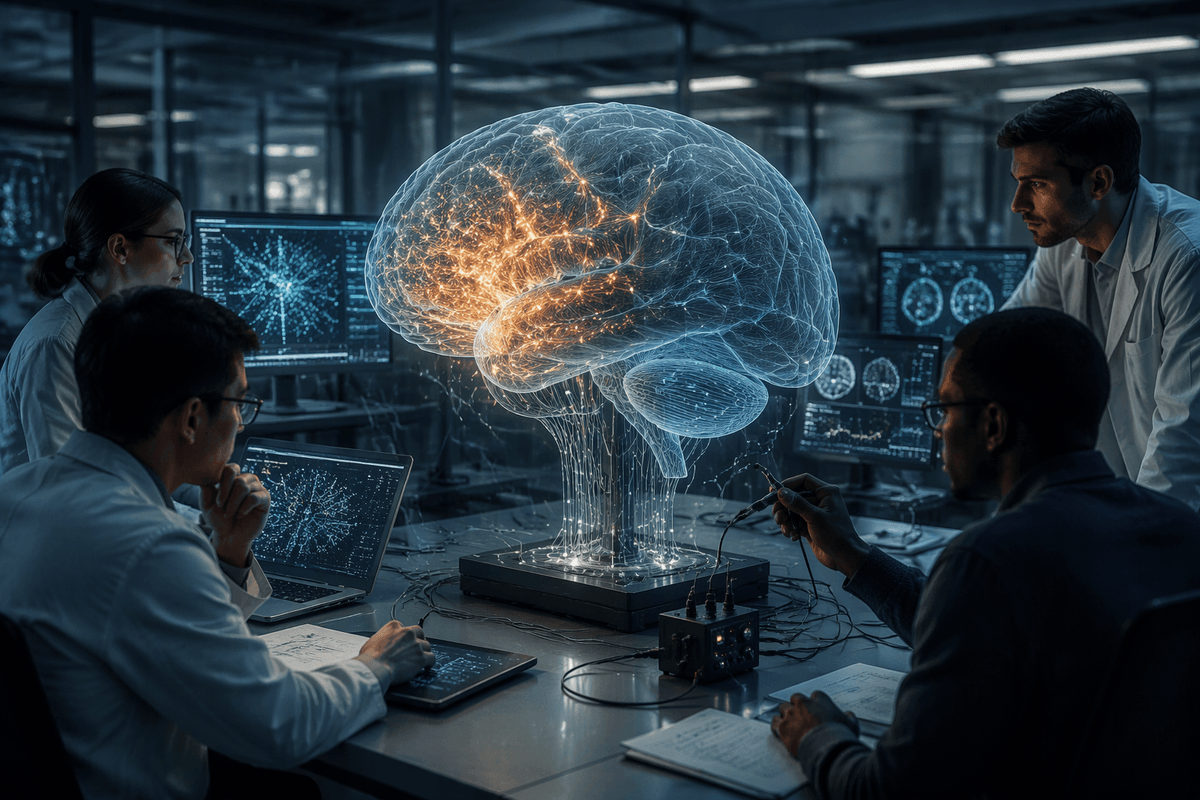
Even partial visibility into a model could change how AI systems are tested and deployed. If researchers can identify signals linked to deception, factual uncertainty, unsafe instructions, or reliance on irrelevant shortcuts, developers may be able to test those behaviors before release. They could compare a model’s stated explanation with the internal activity associated with its answer, rather than treating fluent language as proof of sound reasoning. Interpretability might also help engineers diagnose failures more precisely, showing whether a problem comes from missing information, a misleading pattern, or a circuit that behaves differently outside its training examples.
The benefits would not be automatic. An internal feature that predicts a harmful output might be difficult to remove without weakening useful abilities, and monitoring every relevant pathway could be too expensive for routine use. Interpretability findings could also create false confidence if they work only on selected examples or one model version. Its most valuable role may therefore be narrower and more practical: giving audits, safety tests, and model comparisons better evidence. That would not make AI transparent, but it could make claims about reliability more testable—and expose where confidence is not justified.
A More Honest Way to Understand AI
When an AI system is described as explainable, the useful question is not whether it can produce a convincing story. It is whether researchers can connect its behavior to evidence that holds across inputs, model versions, and real operating conditions. An explanation should identify what was tested, what remains uncertain, and whether changing the proposed cause actually changes the result.
That standard leads to a more practical view of interpretability. It is not a promise to reveal a model’s thoughts or eliminate every surprise. It is a set of tools for finding patterns, testing causes, and measuring where understanding breaks down. AI may remain partly opaque, but careful investigation can replace vague confidence with limited, verifiable knowledge—and make decisions about using these systems more honest.